RAISE YOUR VOICE OR TAKE ACTION— EVERY MOVE ADVANCES ACCESS, EQUITY + BELONGING
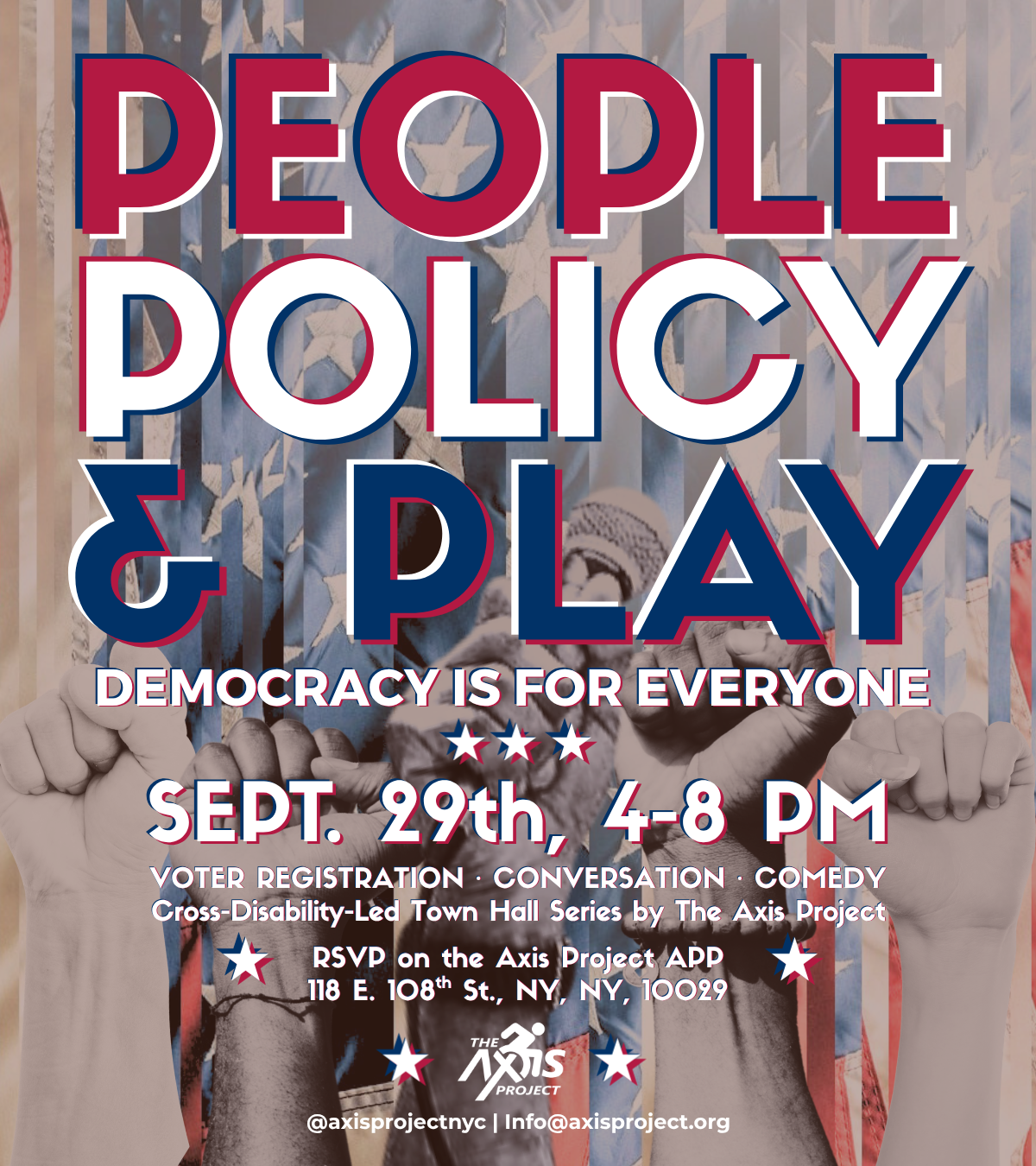
Image description: A shredded American flag forms the background, with diverse raised fists reaching upward in the foreground. Bold red, white, and blue text promotes People, Policy + Play: Democracy Is for Everyone, September 29 at The Axis Project.
PEOPLE, POLICY + PLAYDemocracy Is for Everyone
People, Policy + Play is The Axis Project’s six-part, cross-disability series bringing disabled people together with policymakers, advocates, public agencies, healthcare leaders, culture, and community to explore the issues shaping ALL of our lives..
Our launch event, Democracy Is for Everyone, gets into who holds power, how decisions get made, and how we can organize, advocate, and shape the policies that impact our lives.
Come register, connect, learn, take action—and laugh.
THE PROGRAM
4–5:15 PM — Register. Mingle. Grab a Slice.
5:30–7 PM — Policy, Power + Perspectives
7–8 PM — Limitless Laughs Comedy Show
8:30 PM — Close
September 29 | The Axis Project, East Harlem
Wheelchair Accessible | ASL Interpretation Provided | Nonpartisan
RSVP IN THE AXIS PROJECT APP OR EMAIL INFO@AXISPROJECT.org
FEATURED SPEAKERS

Commissioner Nisha Agarwal
Commissioner, New York City Mayor’s Office for People with Disabilities | A longtime public servant, public interest attorney, and advocate whose career spans disability, health, immigration, and civic engagement, working across government and community to advance accessibility, equity, and opportunity for New Yorkers.

Yaw Appiadu
Executive Director, Harlem Independent Living Center & Chair, NYSILC | A longtime independent living advocate and community leader advancing disability rights, accessible housing, healthcare access, and independent living through advocacy, partnerships, and systems change.
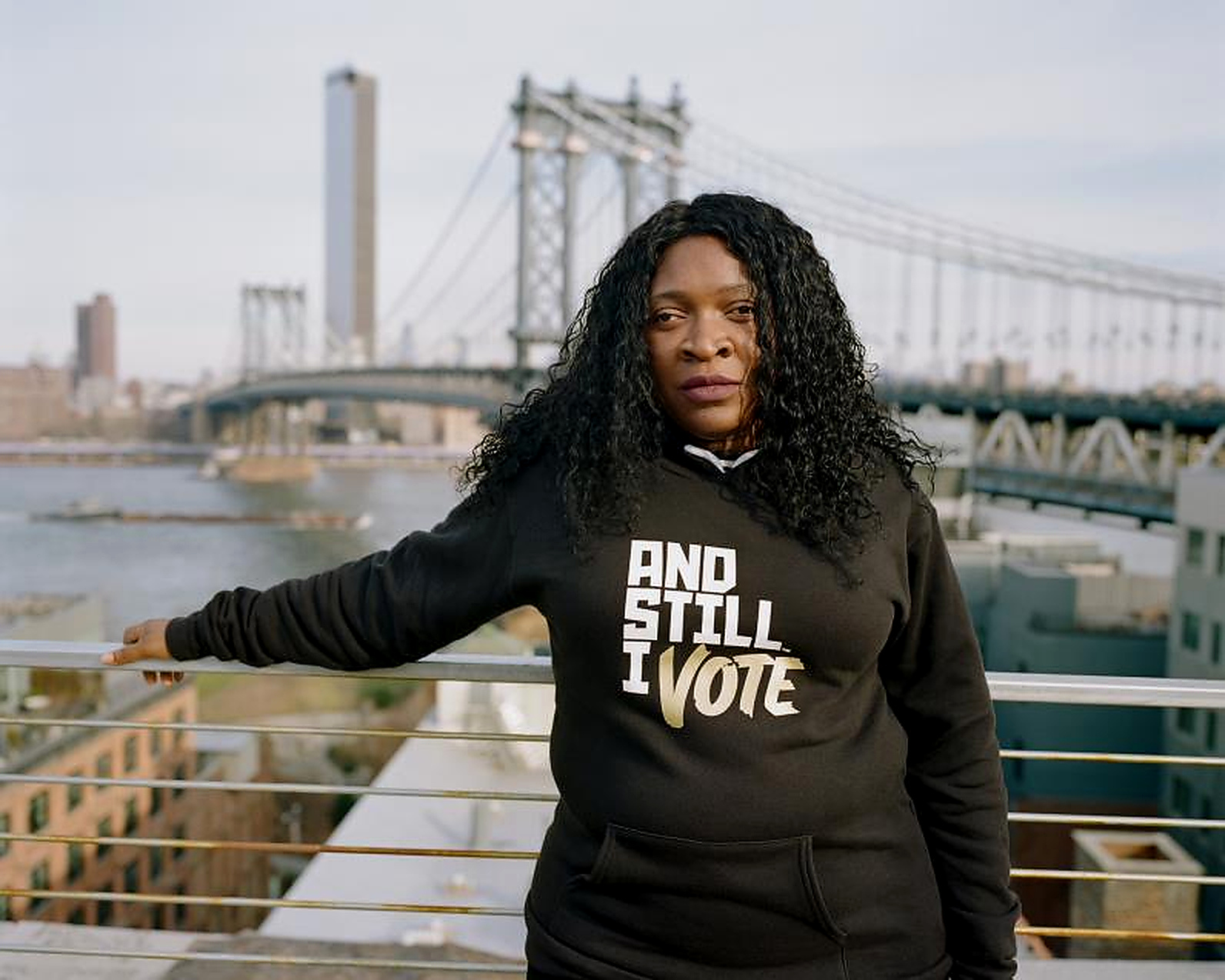
Rasheta Bunting
Rasheta Bunting, M.Ed., Executive Director, One Heart One Vision | A disability rights activist, special educator, entrepreneur, and civic engagement leader whose leadership spans the National Federation of the Blind of New York State, NYSILC, and Disabled in Action, advancing accessibility, equity, and inclusion across communities.

Rebecca Cokley
Director, U.S. Disability Rights Program, Ford Foundation | A nationally recognized disability rights leader, advocate, and three-time presidential appointee advancing disability justice, economic equity, and opportunity for disabled people through policy, advocacy, and systems change.
George Gallego
Founder & Executive Director of The Axis Project, CEO of Access Initiatives LLC | A nationally recognized disability advocate, nonprofit leader, and world-class adaptive athlete who has represented Team USA and the U.S. National Triathlon Team while advancing access, independence, and opportunity for disabled people.

Council Member Shahana Hanif
New York City Council Member, District 39 & Chair, Committee on Disabilities | A Brooklyn-born public servant whose work spans disability access, healthcare, civic engagement, immigrant and worker protections, and community-based policymaking across New York City.
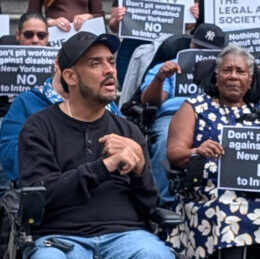
José Hernandez
Association NYC Chapter | A longtime disability rights advocate, policy strategist, and peer mentor advancing independent living, accessible transportation, home care, healthcare access, and civic participation for disabled New Yorkers

Luke Messina
Senior Accessibility Specialist, NYC Votes | An accessibility and civic engagement specialist working with New York City’s disability community to make voting information, materials, and workshops more accessible to New Yorkers.

Chris Noel
Accessibility & Inclusion Leader | A longtime disability advocate, accessibility leader, peer mentor, and adaptive athlete who formerly served as ADA Accessibility Coordinator for NYC Parks, advancing access, inclusion, and recreation for disabled New Yorkers.

Danniel Swatosh
Chief Strategy & Brand Officer, The Axis Project | A community strategist, brand leader, artist, and advocate creating accessible, joyful spaces at the intersection of disability, wellness, culture, equity, and community.
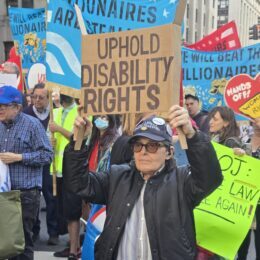
Mike Schweinsburg
Disability Rights & Civic Engagement Leader | A longtime disability rights advocate recognized for helping organize New York City’s first Disability Pride Parade and advancing the designation of July as Disability Pride Month. His work spans accessibility, civic and voting participation, healthcare access, employment, and disability representation across New York.
LIMITLESS LAUGHS COMEDY SHOW
Brought to you by Limitless Laughs Productions.

Pavar Snipe
Comedian, Actor, Writer, Producer & Disability Advocate | An Emmy-nominated producer and multidisciplinary performer whose comedy and storytelling span television, voice acting, live performance, and disability advocacy.

Nick Astor
Comedian | A Brooklyn-based physically disabled comedian turning the collisions between disability, everyday life, and the world around him into comedy.

Liv Talley
Comedian, Actress, Writer & Host | A New York comedian bringing wit and humor to her experiences with serious medical conditions, family, and everyday life—with plenty of “Liv Laughs” along the way.

Pamela Rae Schuller
Comedian, Storyteller & Disability Advocate | An internationally known performer who transforms her experiences with Tourette Syndrome, OCD, disability, and difference into sharp, joyful comedy about authenticity and inclusion.
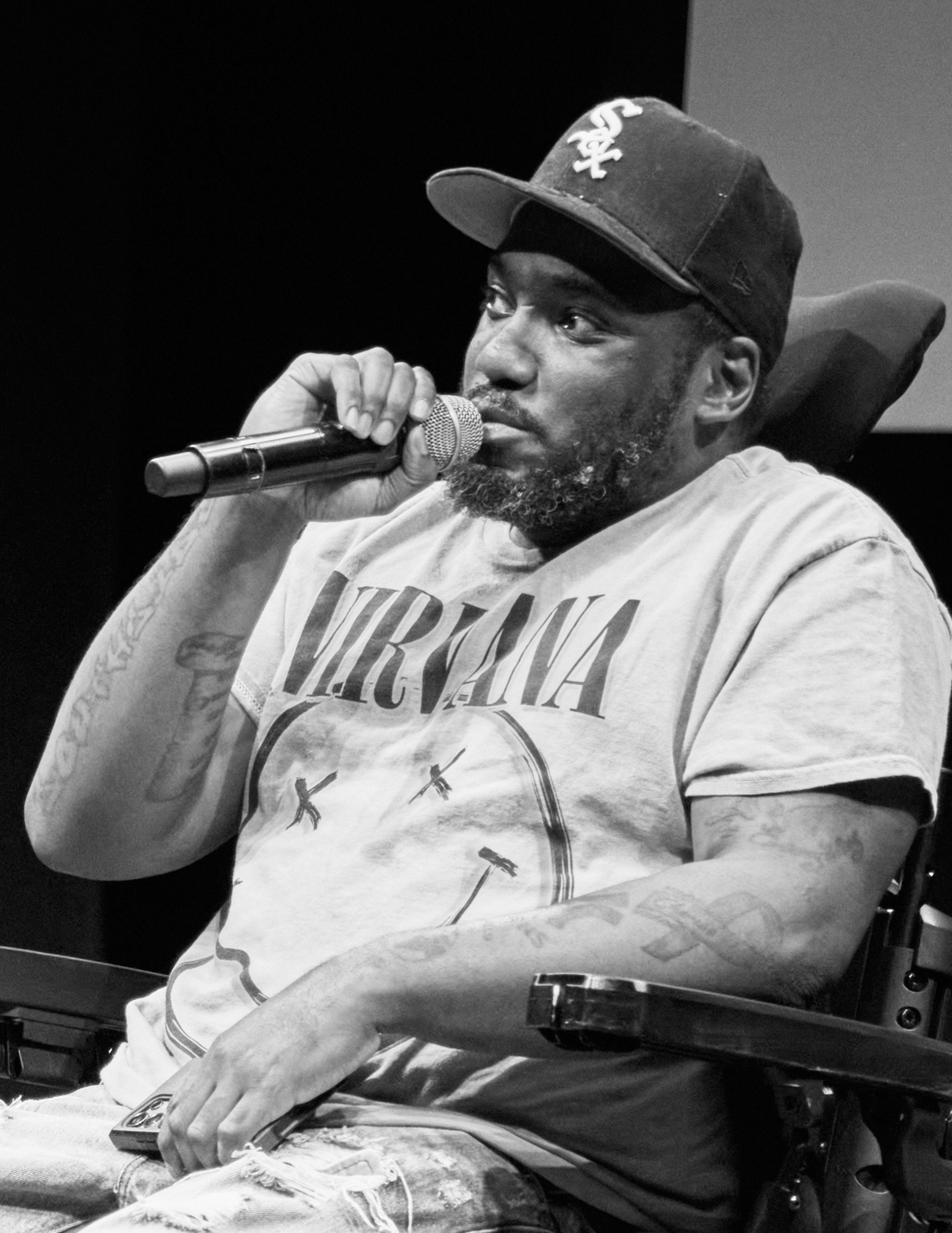
Mike Favor
Comedian | The 2023 Laughing Buddha Festival Champion and New York Comedy Festival alum who has performed on stages across New York City, including Lincoln Center.
MAKE YOUR VOTING PLAN
New York — 2026 General Election
ELECTION DAY
Tuesday, November 3, 2026
Polls open 6 AM–9 PM.
REGISTER TO VOTE
Deadline: October 24
Register to Vote
EARLY VOTING
October 24–November 1
Early Voting Information
VOTE BY MAIL
Any registered New York voter can request an Early Mail Ballot.
Request a Ballot
ACCESSIBLE VOTING
Voters with disabilities have the right to accessible voting and assistance at the polls.
Accessible Voting Information
KNOW BEFORE YOU GO
Check your registration and find your polling location.
Voter Lookup + Poll Site
VOTE → PARTICIPATE → UNDERSTAND POWER → ORGANIZE → SHAPE POLICY → BELONG → ACT
Know Your Rights: Landmark Disability Legislation
Americans with Disabilities ACT 1990, As Amended
Signed into law on July 26, 1990, by President George H.W. Bush, the Americans with Disabilities Act (ADA) is a landmark civil rights law prohibiting discrimination against individuals with disabilities in all areas of public life, including jobs, schools, transportation, and public/private places. It ensures equal opportunity and access, requiring reasonable accommodations, and covers physical and mental impairments.
Here is the text of the Americans with Disabilities Act of 1990 (ADA), including changes made by the ADA Amendments Act of 2008. Congress passed the ADA as a “Public Law,” and it originally was in a different format than presented here. To make the law more widely available, the ADA was later reformatted and published in volume 42 (called “title 42”) of the United States Code. One small part of the ADA is found in title 47 of the United States Code. The text below mirrors the law as it is found in the U.S. Code. Because the numbering system is different in the U.S. Code, the headings provide in brackets the title numbers of the ADA as originally enacted.
Key Titles of the ADA
- Title I: Employment: Prohibits employers with 15 or more employees from discriminating against qualified individuals with disabilities in hiring, firing, and promotions.
- Title II: State and Local Government: Prohibits discrimination by all public entities, including public transportation and services.
- Title III: Public Accommodations: Requires private businesses (restaurants, hotels, theaters) to provide accessibility to customers with disabilities.
- Title IV: Telecommunications: Mandates telecommunications services for individuals with hearing or speech impairments.
- Title V: Miscellaneous: Includes technical provisions and connects the ADA to other laws.
Important Information
- Definition of Disability: The ADA covers physical or mental impairments that substantially limit major life activities.
- Amendments (ADAAA): The ADA was amended in 2008 to broaden the definition of disability and expand coverage.
- Enforcement: Key agencies enforcing the ADA include the EEOC and the Department of Justice.
ADA Information Line
Talk to us at 800-514-0301 | 1-833-610-1264 (TTY)
Monday-Friday
Community Outreach Coordinator
Disability.Outreach@usdoj.gov
Affordable Care Act (ACA) 2010
The law has 2 parts: the Patient Protection and Affordable Care Act and the Health Care and Education Reconciliation Act.
- Certified full-text version: Affordable Care Act (PDF – 2.41 MB)
- Certified full-text version: Reconciliation Act (PDF – 257 KB)
Summary and certified full-text version in HTML (web page) format:
Learn more about your rights and protections.
Together, these acts make up the codified law (Public Law 111-148) which amended the Public Health Service Act and other laws, primarily adding new provisions into Title 42 of the United States Code. [1]
Key Components of the Actual Legislation
The ACA was designed to overhaul the individual insurance market, expand Medicaid, and support new medical delivery methods. Key legislative pillars include: [1]
- Pre-existing Conditions: Insurers are prohibited from denying coverage or charging higher premiums based on health status (Guaranteed Issue).
- Essential Health Benefits: All plans must cover 10 essential benefit categories, including emergency services, maternity care, mental health, and prescription drugs.
- Young Adult Coverage: Allows young adults to remain on their parents' insurance plan until age 26.
- Premium Subsidies: The law provides tax credits to help households with incomes between 100% and 400% of the federal poverty level (FPL) pay for insurance, with expanded subsidies through 2025.
- Medicaid Expansion: Originally, the act expanded Medicaid to cover all adults with income below 138% of the FPL. However, the Supreme Court ruled in 2012 that states could choose whether to participate.
- Individual Mandate ($0 Penalty): The original law required individuals to have health insurance or pay a penalty. The Tax Cuts and Jobs Act of 2017 reduced this penalty to $0 effective January 1, 2019.
- Employer Mandate: Employers with 50 or more full-time employees are required to offer affordable, minimum-value coverage or face penalties.
- Medical Loss Ratio (MLR): Insurers must spend 80-85% of premium dollars on health care services, not administrative cost or provide rebates.
The Air Carrier Access Act (ACAA) 1986
The Air Carrier Access Act (ACAA) is a 1986 U.S. law (49 U.S.C. 41705 - Discrimination against handicapped individuals) (read here ) prohibiting airlines from discriminating against passengers with disabilities. It mandates that carriers provide assistance, accessible aircraft features, and accommodations—such as wheelchair services, seating, and service animal access—on all flights to, from, or within the U.S..
Key Requirements and Rights Under the ACAA
- Assistance: Airlines must provide prompt, safe, and dignified assistance with boarding, deplaning, and connecting flights.
- Wheelchairs/Devices: Carriers must transport assistive devices (including electric wheelchairs) and have procedures to safely stow them. A 2024 rule makes mishandling wheelchairs an automatic ACAA violation.
- Accessible Seating: Airlines must provide seats with movable armrests, bulkhead seats, or extra legroom for specific disability needs.
- Service Animals: Only trained service dogs are recognized; emotional support animals are not protected and are treated as pets.
- Digital Accessibility: Airline websites, kiosks, and mobile apps must be accessible. [1, 2, 3, 4, 5, 6, 7, 8]
Enforcement and Regulations
The Department of Transportation (DOT) enforces the ACAA. Passengers who experience discrimination can file a complaint with the DOT. The Airline Passengers with Disabilities Bill of Rights outlines these protections. [1, 2]
Recent Updates (2024–2026)
New regulations require improved on-board wheelchairs (OBWs) on twin-aisle aircraft by 2026, with full fleet compliance by 2031. Training for employees handling mobility devices is also mandated, though enforcement of some 2024 rules was delayed in early 2025.
What to do/where to go for help
Contact the airline with which you are traveling. Many employ designated disability customer service agents. When possible, speak with someone at the airport Speak with a Complaint Resolution Officers (CRO) who will have disability related procedure and resolution training and are available in all US airports in person or by phone 24/7 Follow-up any ACAA violation by filing an incident report with the Department of Transportation or with the airline. Click here for more information on the U.S. Department of Transportation (DOT) Civil Rights Enforcement and Awareness Click here for more information on travel tips and more information from the Federal Aviation Administration (FAA) Click here to visit the United Spinal Association website for information on reporting transportation issues.
Section 504 of the Rehabilitation Act of 1973
Section 504 of the Rehabilitation Act of 1973 is a landmark U.S. civil rights law prohibiting discrimination against people with disabilities in programs and activities that receive federal financial assistance. It was the first federal civil rights law to broadly protect people with disabilities from discrimination and became an important foundation for the Americans with Disabilities Act (ADA).
Section 504 states that a qualified individual with a disability cannot, solely because of their disability, be excluded from participating in, denied the benefits of, or subjected to discrimination under a covered program or activity.
Read Section 504 of the Rehabilitation Act of 1973
Key Requirements and Rights Under Section 504
- Equal Access: Covered programs and services cannot exclude or discriminate against qualified people because of disability.
- Reasonable Accommodations and Modifications: Covered entities may be required to make reasonable changes to policies, practices, services, or environments so people with disabilities have meaningful access.
- Education: Schools receiving federal financial assistance must provide students with disabilities equal access to education. This is the law behind what are commonly called “504 Plans.”
- Healthcare and Human Services: Section 504 applies to many hospitals, healthcare providers, Medicaid and Medicare providers, nursing homes, senior centers, human-service organizations, and other programs receiving federal financial assistance.
- Physical Accessibility: Covered programs cannot deny participation or access because of physical barriers and may be required to ensure facilities and services are accessible.
- Communication and Technology: Depending on the covered program and applicable regulations, Section 504 protections can include effective communication and accessible digital services and technology.
- Protection From Retaliation: Individuals are protected from retaliation for asserting rights or participating in a disability discrimination complaint or investigation.
Section 504 and the Disability Rights Movement
Section 504 was enacted in 1973, but implementing regulations were not issued immediately. Disability activists organized demonstrations around the country in 1977 demanding enforcement of the law. The historic Section 504 Sit-in became a defining moment in the disability rights movement and helped secure the regulations that gave Section 504 practical force.
Section 504 helped establish the principle that disability discrimination is a civil rights issue, laying important groundwork for the Americans with Disabilities Act of 1990.
Enforcement and Regulations
Unlike the ADA, Section 504 is tied primarily to federal financial assistance. Different federal agencies enforce Section 504 for the programs and funding they administer. For example, the U.S. Department of Education's Office for Civil Rights enforces Section 504 in covered educational institutions.
For health and human-service programs receiving federal financial assistance from HHS, the U.S. Department of Health and Human Services Office for Civil Rights (OCR) enforces Section 504. HHS's regulations address areas including accessibility, reasonable modifications, effective communication, medical treatment and accessible medical equipment.
U.S. Department of Education — Section 504 Information
HHS — Section 504 Information and Regulations
What to Do / Where to Go for Help
If you believe your rights under Section 504 have been violated, first identify what type of program or institution is involved and which federal agency provides or administers its federal funding, because enforcement responsibility can vary by agency.
For discrimination involving a school, college, university, or other education program, contact the U.S. Department of Education Office for Civil Rights. Complaints generally must be filed within 180 days of the alleged discrimination, although extensions may be available in certain circumstances.
File a Disability Discrimination Complaint with the U.S. Department of Education OCR
For discrimination involving healthcare or human services, including many hospitals, Medicaid providers, nursing homes, senior programs and social-service providers, contact the U.S. Department of Health and Human Services Office for Civil Rights.
File a Civil Rights Complaint with HHS Office for Civil Rights
HHS Office for Civil Rights:
800-368-1019 (Voice)
800-537-7697 (TDD)