
RAISE YOUR VOICE OR TAKE ACTION— EVERY MOVE ADVANCES ACCESS, EQUITY + BELONGING
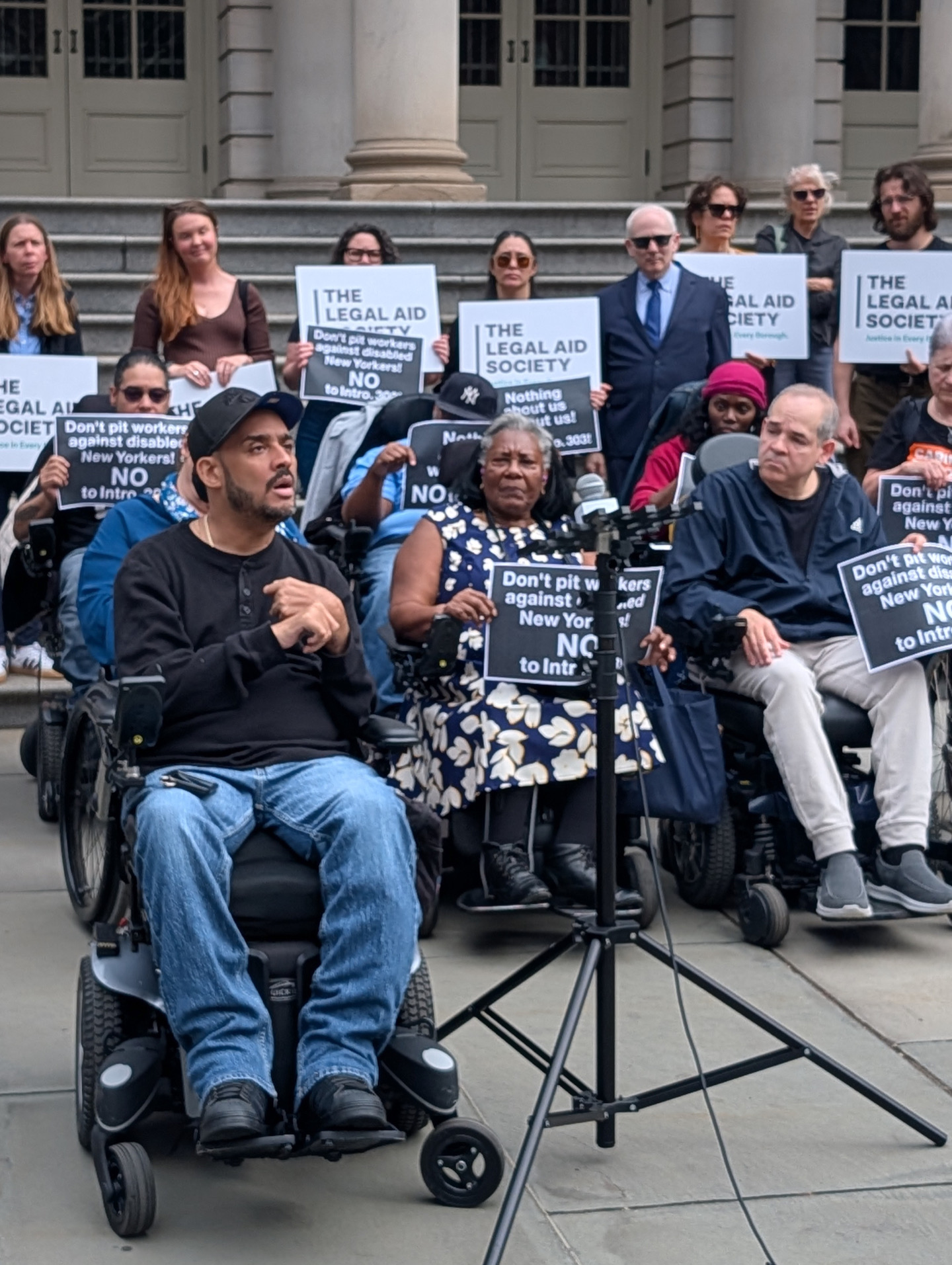
SAY NO TO INTRO 303
Tell City Council to VOTE NO on Intro 303 and post a video testimonial sharing why 24-hour care matters.
Tag @ZohranKMamdani @JulieMenin @NYCCouncil @legalaidnyc @axisprojectnyc
Intro 303 could end 24-hour care as we know it, putting thousands of New Yorkers at risk.
Here’s what you need to know:
- 24-hour care ≠ nonstop work
Includes rest periods within a structured system - Eliminating it won’t fix care gaps
Could leave people without overnight support - Risk of institutionalization
Without continuous care, many can’t remain at home - Mismatch with state policy
Medicaid rules won’t automatically adjust - We can protect workers AND care
Fair pay matters—so does access
Protect home care. Protect dignity. Protect community.
Key Disability Legislation
Americans with Disabilities ACT 1990, As Amended
Signed into law on July 26, 1990, by President George H.W. Bush, the Americans with Disabilities Act (ADA) is a landmark civil rights law prohibiting discrimination against individuals with disabilities in all areas of public life, including jobs, schools, transportation, and public/private places. It ensures equal opportunity and access, requiring reasonable accommodations, and covers physical and mental impairments.
Here is the text of the Americans with Disabilities Act of 1990 (ADA), including changes made by the ADA Amendments Act of 2008. Congress passed the ADA as a “Public Law,” and it originally was in a different format than presented here. To make the law more widely available, the ADA was later reformatted and published in volume 42 (called “title 42”) of the United States Code. One small part of the ADA is found in title 47 of the United States Code. The text below mirrors the law as it is found in the U.S. Code. Because the numbering system is different in the U.S. Code, the headings provide in brackets the title numbers of the ADA as originally enacted.
Key Titles of the ADA
- Title I: Employment: Prohibits employers with 15 or more employees from discriminating against qualified individuals with disabilities in hiring, firing, and promotions.
- Title II: State and Local Government: Prohibits discrimination by all public entities, including public transportation and services.
- Title III: Public Accommodations: Requires private businesses (restaurants, hotels, theaters) to provide accessibility to customers with disabilities.
- Title IV: Telecommunications: Mandates telecommunications services for individuals with hearing or speech impairments.
- Title V: Miscellaneous: Includes technical provisions and connects the ADA to other laws.
Important Information
- Definition of Disability: The ADA covers physical or mental impairments that substantially limit major life activities.
- Amendments (ADAAA): The ADA was amended in 2008 to broaden the definition of disability and expand coverage.
- Enforcement: Key agencies enforcing the ADA include the EEOC and the Department of Justice.
ADA Information Line
Talk to us at 800-514-0301 | 1-833-610-1264 (TTY)
Monday-Friday
Community Outreach Coordinator
Disability.Outreach@usdoj.gov
Affordable Care Act (ACA) 2010
The law has 2 parts: the Patient Protection and Affordable Care Act and the Health Care and Education Reconciliation Act.
- Certified full-text version: Affordable Care Act (PDF – 2.41 MB)
- Certified full-text version: Reconciliation Act (PDF – 257 KB)
Summary and certified full-text version in HTML (web page) format:
Learn more about your rights and protections.
Together, these acts make up the codified law (Public Law 111-148) which amended the Public Health Service Act and other laws, primarily adding new provisions into Title 42 of the United States Code. [1]
Key Components of the Actual Legislation
The ACA was designed to overhaul the individual insurance market, expand Medicaid, and support new medical delivery methods. Key legislative pillars include: [1]
- Pre-existing Conditions: Insurers are prohibited from denying coverage or charging higher premiums based on health status (Guaranteed Issue).
- Essential Health Benefits: All plans must cover 10 essential benefit categories, including emergency services, maternity care, mental health, and prescription drugs.
- Young Adult Coverage: Allows young adults to remain on their parents' insurance plan until age 26.
- Premium Subsidies: The law provides tax credits to help households with incomes between 100% and 400% of the federal poverty level (FPL) pay for insurance, with expanded subsidies through 2025.
- Medicaid Expansion: Originally, the act expanded Medicaid to cover all adults with income below 138% of the FPL. However, the Supreme Court ruled in 2012 that states could choose whether to participate.
- Individual Mandate ($0 Penalty): The original law required individuals to have health insurance or pay a penalty. The Tax Cuts and Jobs Act of 2017 reduced this penalty to $0 effective January 1, 2019.
- Employer Mandate: Employers with 50 or more full-time employees are required to offer affordable, minimum-value coverage or face penalties.
- Medical Loss Ratio (MLR): Insurers must spend 80-85% of premium dollars on health care services, not administrative cost or provide rebates.
The Air Carrier Access Act (ACAA) 1986
The Air Carrier Access Act (ACAA) is a 1986 U.S. law (49 U.S.C. 41705 - Discrimination against handicapped individuals) (read here ) prohibiting airlines from discriminating against passengers with disabilities. It mandates that carriers provide assistance, accessible aircraft features, and accommodations—such as wheelchair services, seating, and service animal access—on all flights to, from, or within the U.S..
Key Requirements and Rights Under the ACAA
- Assistance: Airlines must provide prompt, safe, and dignified assistance with boarding, deplaning, and connecting flights.
- Wheelchairs/Devices: Carriers must transport assistive devices (including electric wheelchairs) and have procedures to safely stow them. A 2024 rule makes mishandling wheelchairs an automatic ACAA violation.
- Accessible Seating: Airlines must provide seats with movable armrests, bulkhead seats, or extra legroom for specific disability needs.
- Service Animals: Only trained service dogs are recognized; emotional support animals are not protected and are treated as pets.
- Digital Accessibility: Airline websites, kiosks, and mobile apps must be accessible. [1, 2, 3, 4, 5, 6, 7, 8]
Enforcement and Regulations
The Department of Transportation (DOT) enforces the ACAA. Passengers who experience discrimination can file a complaint with the DOT. The Airline Passengers with Disabilities Bill of Rights outlines these protections. [1, 2]
Recent Updates (2024–2026)
New regulations require improved on-board wheelchairs (OBWs) on twin-aisle aircraft by 2026, with full fleet compliance by 2031. Training for employees handling mobility devices is also mandated, though enforcement of some 2024 rules was delayed in early 2025.
What to do/where to go for help
Contact the airline with which you are traveling. Many employ designated disability customer service agents. When possible, speak with someone at the airport Speak with a Complaint Resolution Officers (CRO) who will have disability related procedure and resolution training and are available in all US airports in person or by phone 24/7 Follow-up any ACAA violation by filing an incident report with the Department of Transportation or with the airline. Click here for more information on the U.S. Department of Transportation (DOT) Civil Rights Enforcement and Awareness Click here for more information on travel tips and more information from the Federal Aviation Administration (FAA) Click here to visit the United Spinal Association website for information on reporting transportation issues.
The Air Carrier Access Act (ACAA) of 1986
The Air Carrier Access Act (ACAA) is a 1986 U.S. law (read here) prohibiting airlines from discriminating against passengers with disabilities. It mandates that carriers provide assistance, accessible aircraft features, and accommodations—such as wheelchair services, seating, and service animal access—on all flights to, from, or within the U.S..
Key Requirements and Rights Under the ACAA
- Assistance: Airlines must provide prompt, safe, and dignified assistance with boarding, deplaning, and connecting flights.
- Wheelchairs/Devices: Carriers must transport assistive devices (including electric wheelchairs) and have procedures to safely stow them. A 2024 rule makes mishandling wheelchairs an automatic ACAA violation.
- Accessible Seating: Airlines must provide seats with movable armrests, bulkhead seats, or extra legroom for specific disability needs.
- Service Animals: Only trained service dogs are recognized; emotional support animals are not protected and are treated as pets.
- Digital Accessibility: Airline websites, kiosks, and mobile apps must be accessible. [1, 2, 3, 4, 5, 6, 7, 8]
Enforcement and Regulations
The Department of Transportation (DOT) enforces the ACAA. Passengers who experience discrimination can file a complaint with the DOT. The Airline Passengers with Disabilities Bill of Rights outlines these protections. [1, 2]
Recent Updates (2024–2026)
New regulations require improved on-board wheelchairs (OBWs) on twin-aisle aircraft by 2026, with full fleet compliance by 2031. Training for employees handling mobility devices is also mandated, though enforcement of some 2024 rules was delayed in early 2025.
What to do/where to go for help
Contact the airline with which you are traveling. Many employ designated disability customer service agents. When possible, speak with someone at the airport Speak with a Complaint Resolution Officers (CRO) who will have disability related procedure and resolution training and are available in all US airports in person or by phone 24/7 Follow-up any ACAA violation by filing an incident report with the Department of Transportation or with the airline. Click here for more information on the U.S. Department of Transportation (DOT) Civil Rights Enforcement and Awareness Click here for more information on travel tips and more information from the Federal Aviation Administration (FAA) Click here to visit the United Spinal Association website for information on reporting transportation issues.